Somewhere between the demo and the rollout, every team hits the same question: which parts of this job should the software now do? The loud failure is delegating too much and shipping the machine's mistakes. The quiet failure is delegating too little — keeping people on work that was never worth a person.
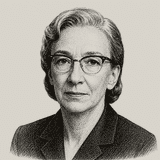
Grace Hopper faced the original version of this question with less help than anyone since. A Navy reservist and mathematician who programmed the Mark I at Harvard in 1944, she spent the early 1950s at Remington Rand building the first compilers — programs that let a programmer write in something nearer to language while the machine produced the machine code. The resistance she met is instructive: programming was a craft, machine code was its proof of skill, and handing any of it to the computer struck many colleagues as both risky and slightly shameful.
Her counterargument was a division of labour, and it has aged into a method. Look inside any skilled job, she argued, and much of it is not judgment at all. It is copying, lookup and arithmetic — transcribing what is already decided from one form into another. People do that layer badly: they tire, they transpose digits, they drift. Machines do it perfectly and without complaint. So the clerical layer belongs to the machine, not because people are being replaced, but because keeping a trained mind on copying work wastes the one thing the machine cannot supply. The programmer freed from bookkeeping, she insisted, becomes more of a programmer, not less of one.
Draw the line inside the task, not around it
The transferable move is where she drew the boundary: inside the task. The rollout debates that go wrong are the ones held at the level of whole jobs — automate the reporting, keep the analysis — as if jobs were atoms. Hers is the sharper decomposition. Take any recurring piece of work and separate the layers: where is something already decided being reformatted, retyped, cross-checked, moved between systems? That layer is clerical whatever the job title above it says, and every pass a human makes over it is an error rate the current arrangement quietly pays for. And where is something genuinely being decided — a threshold set, an exception judged, a trade-off weighed? That layer stays with the person, whatever the tool's marketing says.
The test she would apply to the current generation of tools follows directly: is this use giving the machine the copying, or giving it the deciding? Drafting the fourth version of a standard document from the decided facts is copying with formatting. Choosing what the document commits you to is not. The same tool can be doing either, in the same afternoon, and the boundary is a professional judgment nobody else can make for you — which is why she spent her later career teaching rather than merely building.
Watch out for
The clerical layer is also where apprenticeship has always lived. The junior who checks the figures and formats the reports is doing low-judgment work — and absorbing, through it, how the judgments upstream are made. Strip every clerical task out of a discipline and you may find, a few years on, that nobody grew into the deciding layer. Hopper's own answer was deliberate teaching, which is a real cost the automation case rarely prices.
And her boundary is not stable. What counts as mechanical moves as the machines improve — she moved it herself, against colleagues who had drawn it confidently a decade earlier. Anyone repeating her method today should expect their own line to look conservative sooner than they think, and should plan to redraw it on evidence rather than defend it as identity.
Answer this next
In your own week, which task contains the most hours of pure copying — moving decided things between formats and systems — and what, concretely, keeps a person on it?