A benefits committee sits with a paper. The treatment works, the demand is real, the annual cost per participant is large, and the modelled savings — fewer cardiac events, less diabetes, lower long-term claims — arrive over ten to thirty years.
Median job tenure is about four years.
Somebody says the quiet part, which is not callous but arithmetical: we will pay all of the cost and collect almost none of the benefit. And the committee is right. That is what the numbers say, and no amount of framing changes it.
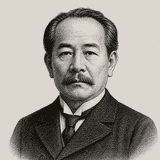
Shibusawa Eiichi spent fifty years on decisions of this exact shape, and his contribution is not a conclusion. It is a question about where the line was drawn before anyone started calculating.
The boundary decides the answer
He promoted several hundred companies in Meiji Japan, and his stated test for a venture was not whether it paid the promoter. It was what the country lacked that a private party could supply. The bank, the exchange, the paper mill, the commercial school: each was argued as something the economy could not do without, with the return to the shareholder as a constraint rather than as the objective.
The transferable part is not the patriotism. It is the observation that the boundary you draw around who counts determines the answer before you calculate anything, and that almost nobody examines the boundary because it does not look like an assumption. It looks like the definition of the problem.
Run it here. The benefits paper is calculated inside the boundary of the firm and the plan year. Inside that boundary the answer is no, permanently, and it would be no for almost any preventive intervention — vaccination programmes, smoking cessation, mental health treatment, anything whose payoff outlasts a job. The committee is not discovering something about this drug. It is discovering the shape of the boundary it was handed.
Widen the boundary by one step and the same facts read differently. The intervention pays; the payer and the beneficiary are simply different parties. That is not a moral discovery either. It is the finding that this cost is sitting on the wrong balance sheet, which is a fact about how health coverage is arranged and not about any employer's generosity.
What that is actually good for
Two things, and both are more useful than an argument about whether firms should be nice.
It tells a committee to stop pretending. A paper that concludes the return does not accrue to us within the tenure is an honest paper, and it should be written that way rather than dressed as a clinical or actuarial finding. What is being decided is a distribution question, and naming it as one is the difference between a decision and a rationalisation.
And it tells you where to look for the fix. If the return leaves with the employee, then the instruments that could work are the ones that follow the person rather than the employer — portability, pooling across employers, or the cost sitting with whoever holds the thirty-year interest. Shibusawa's habit when a venture needed something that did not exist was to go and build the missing institution. Here the missing institution is a payer whose horizon matches the benefit.
Watch out for
His own failure is precisely the one a firm invoking public benefit will commit, and it is worth stating without softening. The boundary was never examined, and it did its heaviest work when it was least visible. The same reasoning that founded a spinning mill at Osaka put his bank into Korea as note issuer and customs collector and financed a railway there. Public benefit with an unexamined edge stops constraining the decision and starts licensing it.
The corporate version writes itself. A company that adopts the wider frame has also appointed itself the body that decides which treatments are worth funding, for whom, on what evidence — and it will draw that edge where its own interests sit, while describing the result as a contribution. His doctrine supplies no arbiter when the ethical and financial readings conflict: it says only that a sound venture would not have them conflict, which hands the decision to whoever already holds it. He opposed Japan's first factory bill in 1896 without ever treating that as a case where his two columns had come apart.
Answer this next
For the benefit decision in front of you, name the party whose balance sheet the return actually lands on, and the year it lands.
If that party is not in the room, you are not making a decision about value. You are making one about who happens to be holding the invoice.