A county paper closes. The coverage was thin by then — a court list, a school board, some sport, a page of notices. The reasonable-sounding response is that the information is available elsewhere: the council streams its meetings, the state paper covers the region, everything is searchable.
The measured consequences do not look like an information problem. What the research keeps finding after a closure is lower turnout in local races, fewer candidates standing at all, and municipal borrowing costs rising because nobody is watching. Those are not the symptoms of a public that has become less informed. They are the symptoms of a public that has become unable to act together.
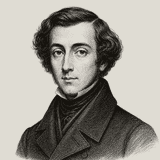
Alexis de Tocqueville explained the difference in 1835, and his argument is more specific than the one usually attributed to him.
Why a democracy needs a medium and an aristocracy does not
His observation was comparative. In an aristocratic society, he said, a few individuals are individually powerful and already known to one another. If ten of them wish to act in concert they simply do; no instrument is required to bring them together, because they are already together.
In a democratic society every individual is weak and they are scattered. A hundred people may share a grievance and never act on it, not because they lack conviction but because none of them knows the other ninety-nine exist. What is missing is not motive and not information. It is the means of discovering that you are numerous.
That is the function he assigned to the newspaper, and he put it as a mutual relation: the newspaper makes the association possible, and the association in turn sustains the newspaper. It reaches many people at the same moment with the same particular fact, and in doing so it converts scattered private irritation into something that can be organised.
Read that way, the closure of a local title is not primarily a subtraction of facts. It is the removal of the mechanism by which strangers with a common problem find out about each other in the same week. Which is exactly what the participation findings look like.
What actually has to be replaced
This reframing has a practical consequence, and it is more hopeful than the usual account.
Replacing local reporting is expensive. A court reporter, a council reporter, an editor and a lawyer cost real money, and no volunteer arrangement has reliably substituted for them.
Replacing the convening function is a different and smaller problem. What that requires is something that reaches most of a defined place at the same time with a specific, local, checkable fact — the licence application, the closure, the rezoning, the date of the hearing. That does not have to be a newspaper, and historically often was not: it has been a noticeboard, a church bulletin, a union sheet, a mailing list.
The test of any proposed replacement is therefore not whether it produces good journalism. It is whether, when something happens on your street, the other people affected by it learn of it in time to find one another.
Watch out for
He assumed that associations school their members in liberty, and this is where his account is weakest. Some school them in faction. A mechanism that lets a hundred scattered strangers discover a shared grievance in one week is precisely as effective when the grievance is ugly, and he badly underestimated how thoroughly combination can serve intolerance. Anyone reading this as an argument that any local information network is civically good has skipped the part his own century demonstrated repeatedly.
There is also a limit on the evidence. His American material comes from a single journey of about nine months in 1831 and 1832, and the press he watched was a scatter of small, fiercely partisan sheets — nothing like the twentieth-century local paper of record whose disappearance is being counted now. The mechanism he identified transfers. His description of the institution does not, and the thing being lost may be a different animal from the one he admired.
Answer this next
Think of the last thing that changed near you that people objected to — a closure, a development, a route.
How did the objectors find each other? If you can answer that, you know where the mechanism currently lives in your area. If you cannot, you have learned something about what is not there.