The requisition comes back with a note. The junior role is not being filled this year. Either it has gone entirely, or it has been rewritten with a list of requirements that reads like the job one level up: judgement, ownership, comfort with ambiguity, three years of something.
The arithmetic behind that is not stupid, which is what makes it worth taking seriously. The work a junior used to do — the first draft, the first pass through the data, the tedious reconciliation nobody wanted — is the work the new tools do most convincingly. A manager comparing a salary against a subscription is not being lazy. They are answering the question they were asked.
The trouble is that it is the wrong question, and there is an unusually direct way to see why.
What was that work producing?
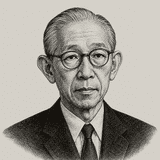
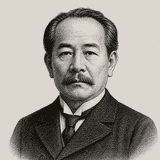
Konosuke Matsushita built his firm around a claim that sounds sentimental until you look at what he actually spent money on. He held that the durable thing a company produces is capable people, and that the goods are what falls out of that. He backed it with institutions rather than statements: worker dormitories from 1922, an employee training school in 1934, a divisional structure from 1933 that handed young managers a profit and loss account of their own long before anyone would have called them ready.
That last one is the part that transfers. He was not being generous. He was manufacturing judgement on purpose, because judgement was the input his expansion depended on and it could not be bought at the rate he needed it.
Run that back through the requisition. Ask what the junior task was producing, and separate the two answers.
As output, the first draft was never worth much. It was slow, it needed checking, and a competent senior could have done it faster alone. That has been true for as long as juniors have existed, and it is why the economics always looked marginal.
As formation, it was doing something else entirely. It was the only reliable mechanism by which anyone acquired the judgement the senior role requires — not through the draft itself, but through writing it badly, having it corrected, and slowly building the sense of what good looks like. Nobody designed that. It was a by-product, which is precisely why it can be removed without anyone noticing they have removed it.
The cost does not disappear, it moves
If the forming work is now done by a machine, the cost of forming people has not been eliminated. It has been deferred, and it has changed hands.
Deferred, because the senior you will need in 2032 comes from a cohort that never had a first rung. Changed hands, because whoever is still training people is now subsidising everybody who is not — the firm that skips the junior role and hires experienced people later is buying capability someone else paid to produce, and that arrangement only works while enough others are still paying.
The practical version is uncomfortable but at least it is honest. Formation now has to be built deliberately rather than harvested. That means a budget line, a named piece of work whose purpose is that a person can do something afterwards they could not do before, and somebody senior whose time is spent on it and counted.
Watch out for
The serious objection is that formation and indoctrination are indistinguishable from inside, and his own machinery is the evidence. The training school came with a creed recited at company assemblies from 1933 and a company song. Historians of the period, Tsutsui among them, describe familial language being used across the industry to soften scientific management — a technique with American versions too. A company that talks about developing its people while what it is really doing is producing employees who can only work here has met the letter of this and none of the point.
There is a second caution that has nothing to do with him. This is also the argument any comfortable manager reaches for when defending headcount, and it is nearly unfalsifiable in that use. The test that makes it honest is specific: name what the person will be able to do at the end of the year that they cannot do now, and name the work that will get them there. If you cannot, the role was not training anyone, and cutting it costs the future nothing.
Answer this next
Name the last person your team made genuinely competent, and the specific work that did it.
Then check whether that work is still on anybody's plate. If a machine has it now, formation is a line item you have not budgeted for yet.