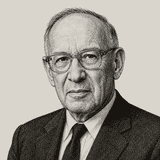
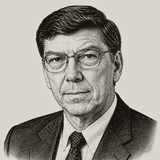
By 1985 Intel had been a memory company for its entire existence. Memory chips were what it had invented, what it was known for, and what its engineers had built their careers on. Japanese manufacturers had spent several years undercutting it on price and beating it on quality, and Intel had spent those same years funding the fight and losing money.
Grove was Intel's president then, Gordon Moore its chairman and chief executive. The conversation the two of them had that year is one Grove retold in his own book a decade later — worth holding as his retelling rather than as a transcript, since it is essentially the only account of it.
He asked what would happen if the board threw them both out and brought in a new chief executive. Both of them knew the answer immediately: a stranger would get Intel out of memory. So, in his account, the two of them walked out of the room, came back in, and did it themselves.
The decision is not the interesting part. The facts supporting it had been available for years. The interesting part is that the people best placed to read those facts were the ones least able to act on them.
Replace yourself with a stranger
The device is small, and it is the whole of the method here.
Everyone inside a business carries something a newcomer does not: the years spent building the thing, the argument won to get it funded, the people hired into it, the version of themselves that was right about it once. None of that is visible in the numbers, and all of it is on the scale. A newcomer inherits the position without the history, and sees only what the position is worth now.
So: name the product line, the service, the account, the market you would not begin today knowing what you now know. Most people can answer in about four seconds. That speed is the finding — it means the analysis was never missing. What was missing was permission to act on it.
The question does not tell you to leave. Plenty of things worth keeping would not be started today, and some of them are load-bearing in ways a stranger would miss. What it does is convert a drift nobody has named into a decision with someone's name on it. You are now either choosing to keep the thing, for a reason you can say out loud, or you have found what you have been avoiding.
The same instinct, nine years later
In 1994 a mathematician found that the Pentium's floating-point unit returned a wrong answer on certain rare divisions. Grove trusted Intel's own statistics, judged it a fault almost no user would ever meet, and authorised replacements only for people who could demonstrate they needed one.
To a public that had just been taught to trust the chip inside the machine, that read as contempt. The story ran until Intel took a charge of roughly $475 million to replace any part on demand.
Same instinct — trust your own reading over the noise around it. Opposite outcome. And the sharpest detail comes afterwards: he folded the episode into his own framework as a case study, turning his worst judgment into evidence for his theory.
Which is the honest warning to carry out of 1985. The stranger's question contains no clock. It tells you what a newcomer would do, not whether this is the moment — and the signal and the noise look identical for exactly as long as it matters. Call it early and you abandon a sound business chasing a phantom. Call it late and you are the last one out of the building. Both failures feel like conviction from the inside, which is what 1994 cost him.
Answer this next
What would you not start today — and what are you actually keeping it for?